
Rubber plays an important role in many products, from vehicle parts and industrial seals to hoses, gaskets and machinery components.
However, different types of rubber offer different properties. When comparing natural vs synthetic rubber, factors such as flexibility, strength, temperature resistance and chemical resistance can affect the final choice.
In this blog, we will look at the key differences, properties, and applications of natural and synthetic rubber to help you understand which material may be suitable for different needs.
Natural vs Synthetic Rubber: What Is the Difference?
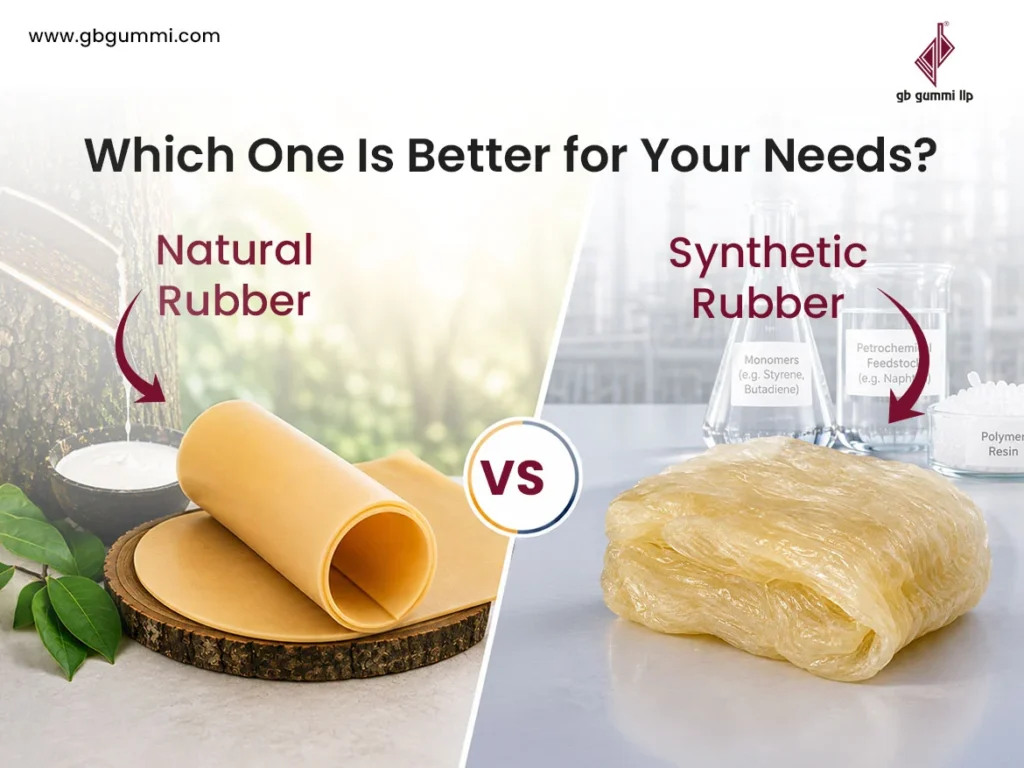
Natural rubber mainly comes from latex collected from rubber trees. This latex is processed to make a material that is flexible, strong, and able to stretch well. A natural rubber compound can stretch and return to its original shape easily. Therefore, it is a good choice for products that face repeated movement, impact, or vibration.
Synthetic rubber, on the other hand, is manufactured through chemical processes. Manufacturers can formulate it to provide specific properties based on the requirements of an application.
Therefore, one of the main differences between natural vs synthetic rubber is how they are produced. Their performance also differs. Natural rubber generally offers excellent elasticity and mechanical strength. Meanwhile, different synthetic rubbers can provide better resistance to oil, fuel, chemicals, heat, ozone, and weather.
Key Properties of Natural vs Synthetic Rubber
Both natural and synthetic rubber provide useful performance characteristics. However, their suitability depends on the conditions in which the component will operate.
Some important properties include:
- Elasticity: Natural rubber offers excellent elasticity and performs well under repeated stretching.
- Tensile strength: A well-developed natural rubber compound can provide high tensile and tear strength.
- Abrasion resistance: Natural rubber can perform effectively in applications involving friction and repeated movement.
- Heat resistance: Certain synthetic rubbers can handle higher operating temperatures better than natural rubber.
- Oil and fuel resistance: Materials such as HNBR rubber provide strong resistance to oils and fuels.
- Weather resistance: Some synthetic rubbers offer better resistance to sunlight, ozone, moisture, and changing weather conditions.
As a result, the natural vs synthetic rubber comparison does not have one clear winner. Instead, manufacturers need to match the material’s properties to the application’s requirements.
Common Types of Synthetic Rubber and Their Applications
Synthetic rubber includes several materials, each developed to offer specific characteristics. Therefore, understanding these options can make material selection easier.
- SBR Compound: Styrene-Butadiene Rubber offers good abrasion resistance, durability, and general-purpose performance. As a result, manufacturers use it in tires, footwear, conveyor belts, and various industrial rubber products.
- HNBR rubber: Hydrogenated Nitrile Butadiene Rubber provides strong resistance to heat, oils, fuels and several chemicals. Therefore, it is commonly used for seals, O-rings, hoses, belts and demanding automotive components.
- EPDM: EPDM offers excellent resistance to weather, ozone, sunlight and water. Consequently, it is commonly used for outdoor applications, automotive weather seals and roofing products.
- Nitrile Rubber: NBR provides good resistance to oils and fuels. Therefore, manufacturers commonly use it for O-rings, seals, gaskets and hoses.
Synthetic rubber lets manufacturers choose a material based on specific operating conditions. Consequently, it can be particularly useful for applications where natural rubber may not provide enough resistance.
Natural vs Synthetic Rubber: How to Choose the Right Material
Choosing between natural vs synthetic rubber requires more than comparing their basic properties. Instead, manufacturers should consider where the component will operate and what conditions it will face throughout its service life.
Temperature is one important factor. For example, an application exposed to high heat may require a synthetic rubber designed for greater temperature resistance. Similarly, components that regularly come into contact with oils, fuels or chemicals need materials that can withstand such exposure.
Mechanical requirements also matter. Natural rubber may be suitable when high elasticity, tensile strength and resistance to repeated movement are important. However, synthetic rubber may be a better choice when resistance to weather, chemicals or demanding temperatures is the priority.
Therefore, the right choice depends on the complete operating environment rather than a single property.
Natural vs Synthetic Rubber Across Different Industries
The natural vs synthetic rubber comparison becomes especially important when we look at different industrial applications.
Natural rubber is widely used where flexibility, elasticity and mechanical strength are important. For instance, it is used in tires, conveyor belts, vibration mounts, shock absorbers, and several general industrial components.
Meanwhile, synthetic rubber supports applications that require more specialized performance. Automotive manufacturers use different synthetic rubbers for seals, hoses, belts and under-the-hood components. Likewise, oil and gas applications may require compounds that can handle fuels, oils, chemicals and demanding temperatures.
Additionally, industries such as aerospace, construction, manufacturing and power generation use different rubber compounds based on their specific operating requirements.
Ultimately, choosing between natural and synthetic rubber is not about finding one material that performs best everywhere. Instead, it is about selecting a material whose properties match the intended application.
GB Gummi: Developing Rubber Compounds for Different Applications
At GB Gummi, we understand that every rubber application has different performance requirements. Therefore, we look beyond the basic natural vs synthetic rubber comparison and focus on the actual conditions in which a component needs to perform.
As an experienced rubber company, we develop rubber compounds by looking at important factors like temperature, chemicals, strength, flexibility, wear, and durability. This helps us choose the right material for different industrial needs.
Whether an application needs a natural rubber compound, SBR Compound, HNBR rubber, or another type of rubber, we focus on making compounds that match its specific needs. By understanding how each material works in real conditions, we help customers choose reliable rubber solutions for their applications.