
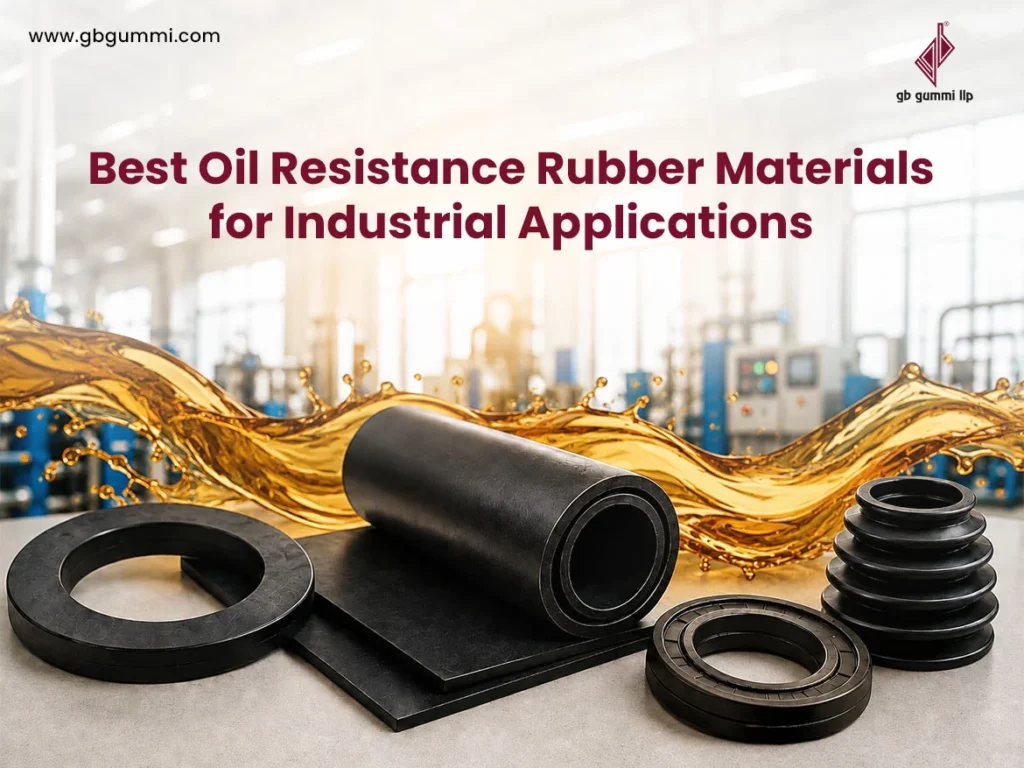
Rubber components used in engines, hydraulic systems and industrial machinery often come into contact with oils, fuels and lubricants. However, regular exposure can cause unsuitable rubber to swell, soften or lose its strength. Therefore, choosing the right oil-resistant rubber is important for maintaining reliable performance.
The right material can retain its shape, flexibility and sealing properties even under demanding conditions. As a result, it can help prevent leaks, reduce premature component failure and support longer service life across automotive and industrial applications.
In this blog, we explore the main types of oil-resistant rubber, their properties and how to choose the right one for your application.
Why Is Oil Resistance Rubber Important?
When rubber comes into contact with oil, the fluid can penetrate the material and change its physical properties. As a result, the rubber may expand, become softer, or lose its sealing ability. Over time, this can lead to leaks, reduced performance, and premature component failure.
For this reason, manufacturers carefully select oil-resistant rubber according to the conditions in which a component will operate. A good oil-resistant compound helps retain its shape, strength and flexibility even after prolonged exposure.
The right material can therefore help improve reliability in applications such as engines, pumps, compressors, hydraulic systems and industrial machinery. Moreover, suitable rubber compounds can reduce maintenance requirements and help components perform consistently under demanding conditions.
Common Types of Oil Resistance Rubber
Several elastomers resist oils and fuels. However, their performance varies depending on temperature, chemical exposure, and mechanical requirements.
- NBR (Nitrile Rubber): NBR is one of the most widely used materials for applications involving petroleum-based oils and fuels. It provides good resistance to oils, greases and many hydraulic fluids. Additionally, it offers good mechanical strength and abrasion resistance. Therefore, manufacturers often use NBR for seals, O-rings, gaskets and hoses.
- HNBR: HNBR material is an enhanced form of nitrile rubber. It provides improved resistance to heat, oxidation, and mechanical stress while maintaining good oil resistance. As a result, it works well in demanding automotive and industrial environments.
- FKM: FKM Compound offers excellent resistance to oils, fuels, chemicals and elevated temperatures. Therefore, it is commonly selected for applications where standard nitrile compounds may not provide sufficient performance. FKM is widely used in automotive, aerospace, chemical processing, and other demanding industries.
Each material provides different advantages. Therefore, understanding the actual working conditions helps determine which compound will deliver reliable performance.
Choosing the Right Oil Resistance Rubber for Your Application
Selecting oil-resistant rubber involves more than simply checking whether a material can tolerate oil. Instead, manufacturers should consider the complete operating environment.
Important factors include:
- The type of oil, fuel, or lubricant that will contact the rubber.
- The minimum and maximum operating temperatures.
- The amount and duration of fluid exposure.
- Required tensile strength and flexibility.
- Compression and sealing requirements.
- Exposure to chemicals, weathering, or ozone.
For example, NBR may provide a practical solution for many standard oil-handling applications. However, when higher temperatures or aggressive fluids are present, HNBR material or FKM Compound may offer better long-term performance.
Therefore, material selection should always reflect the application rather than relying on a single rubber type for every requirement.
Oil Resistance Rubber Applications Across Industries
Because oil-resistant rubber maintains its properties around lubricants and fuels, industries use it in many critical components. Automotive systems, for instance, contain numerous seals, hoses and gaskets that frequently come into contact with engine oils, transmission fluids and fuels.
Similarly, industrial machinery relies on oil-resistant components within hydraulic systems, pumps and compressors. Oil and gas equipment also requires materials that can handle hydrocarbons while maintaining reliable sealing performance.
Other common applications include O-rings, shaft seals, diaphragms, valve seals, fuel-system components, hydraulic seals and industrial gaskets.
However, application requirements can differ significantly. A seal operating inside a high-temperature engine faces different conditions from a gasket used in general industrial machinery. Consequently, selecting the correct oil-resistant rubber helps manufacturers improve durability and reduce the risk of premature failure.
NBR vs HNBR vs FKM for Oil Resistance Rubber
NBR, HNBR, and FKM can all perform well around oils, although each material serves different operating conditions.
NBR remains a widely used choice because it provides strong oil resistance together with useful mechanical properties. Meanwhile, HNBR material offers improved heat resistance and durability, making it suitable for more demanding conditions.
On the other hand, FKM Compound can provide excellent performance where components encounter high temperatures, fuels, and aggressive chemicals. Therefore, FKM often suits applications that require greater chemical and thermal resistance.
Ultimately, the best oil-resistant rubber depends on the fluid, temperature, pressure, mechanical stress, and expected service life of the component.
GB Gummi for Reliable Oil-Resistant Rubber Solutions
At GB Gummi, we understand that choosing the right rubber compound can directly affect an industrial component’s durability and reliability. As a rubber company in India, we develop rubber compounds that meet different environmental, mechanical, and chemical requirements.
As an experienced rubber manufacturing company, we work with customers to understand operating conditions, application demands, and performance expectations before recommending suitable materials. Whether the requirement involves NBR, HNBR, FKM, or another specialized compound, we focus on delivering solutions designed for consistent performance.
At GB Gummi, we aim to help manufacturers choose materials that offer the right balance of oil resistance, temperature performance, durability, and mechanical strength for their applications.