
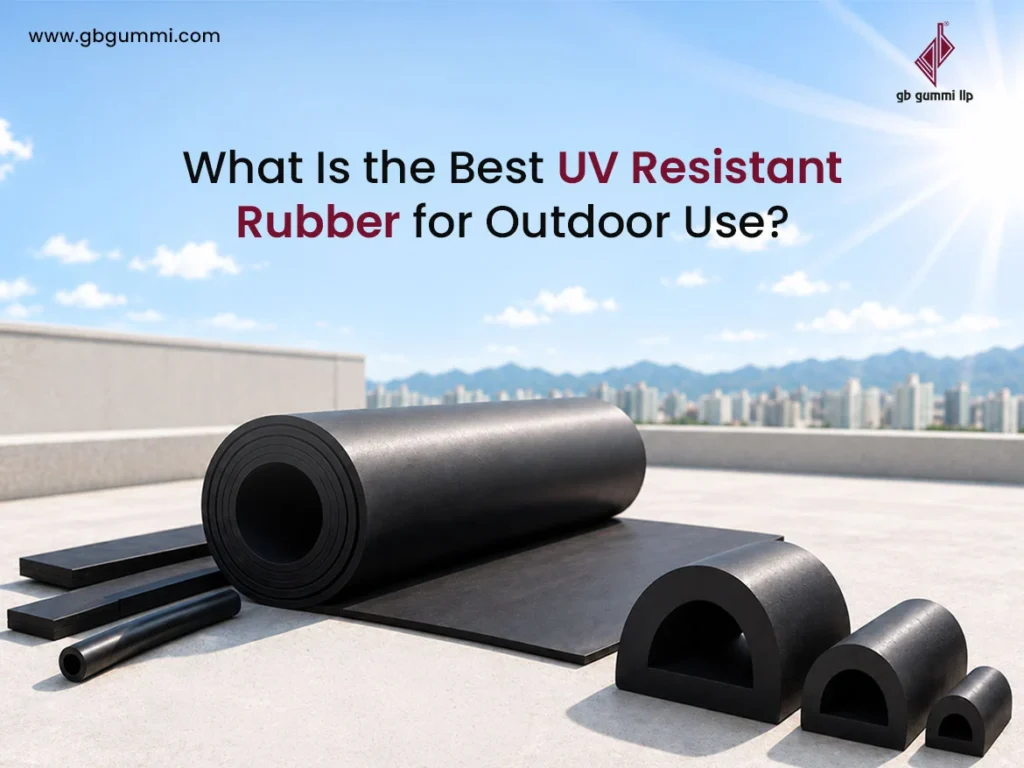
Rubber parts used outdoors are exposed to sunlight, heat, rain, moisture, ozone, and changing weather. Over time, UV rays can make some types of rubber crack, harden, fade, or lose flexibility. Therefore, choosing the right UV-resistant rubber is important for products that need to stay strong and work well outdoors for a long time.
Among the different rubber materials available, EPDM is often a preferred choice because of its strong resistance to UV radiation, ozone, and weathering.
In this blog, we look at what makes rubber UV-resistant, which materials perform well outdoors, and how to choose the right rubber for different applications.
What Makes UV-Resistant Rubber Suitable for Outdoor Use?
UV radiation can slowly affect rubber’s molecular structure. As a result, the material may become brittle, develop cracks, lose elasticity, or weaken over time. However, some elastomers naturally handle sunlight and environmental exposure better than others.
A good UV-resistant rubber should offer several important properties:
- Strong resistance to sunlight and ultraviolet radiation
- Good resistance to ozone and oxidation
- Ability to handle changing temperatures
- Resistance to rain, moisture, and outdoor weather
- Long-term flexibility and dimensional stability
- Suitable mechanical strength for the application
For this reason, material selection should never depend on UV resistance alone. Manufacturers must also consider temperature, chemicals, pressure, movement, abrasion, and the component’s expected service life.
Among commonly used materials, EPDM rubber compound is a good choice for outdoor use. EPDM stands for Ethylene Propylene Diene Monomer. It can handle sunlight, rain, water, ozone, and changing weather conditions, making it suitable for many outdoor rubber products.
Therefore, EPDM appears in many outdoor products, including:
- Automotive weather strips and window seals
- Roofing membranes and construction seals
- Outdoor gaskets and profiles
- Electrical insulation components
- Industrial hoses and sealing parts
- HVAC and infrastructure applications
Moreover, manufacturers can modify an EPDM rubber compound according to the required hardness, tensile strength, flexibility, compression set, and temperature resistance. As a result, businesses can use EPDM across many industries rather than limiting it to one type of application.
Which Rubber Materials Offer the Best UV Resistance?
Although EPDM is one of the most popular options, different applications may require different materials. Therefore, understanding the strengths of each rubber type can help businesses make the right choice.
EPDM offers excellent resistance to UV rays, ozone, moisture, and outdoor weather. It also maintains good flexibility across a wide temperature range. Because of these properties, EPDM is often a strong choice when long-term outdoor performance matters. A trusted rubber company can also adjust EPDM formulations to suit specific environmental and mechanical requirements.
Silicone rubber can handle sunlight, ozone, and very high or low temperatures. Therefore, it is often used in products that must perform well even as temperatures change. However, silicone can be more expensive than other types of rubber and may not be strong enough for every application.
Neoprene provides good resistance to sunlight, weathering, ozone, oils, and certain chemicals. As a result, it works well in applications where components face both outdoor exposure and occasional contact with oils or industrial fluids.
Natural rubber offers excellent elasticity and mechanical strength. However, it does not naturally provide the same level of UV and ozone resistance as EPDM. Therefore, a rubber manufacturing company may need to add protective additives or modify the formulation when natural rubber must operate outdoors.
When choosing UV-resistant rubber, businesses should consider:
- Duration and intensity of sunlight exposure.
- Operating temperature range.
- Ozone and moisture levels.
- Chemical exposure.
- Mechanical load and movement.
- Required hardness and flexibility.
- Expected product lifespan.
- Industry-specific performance requirements.
Even two components made from the same base polymer can perform differently because compound formulation, additives, curing methods, and manufacturing quality all influence durability.
Therefore, working with an experienced rubber company in India can help businesses select materials based on actual operating conditions rather than relying only on general material properties.
How We Develop UV Resistant Rubber Solutions at GB Gummi
At GB Gummi, we understand that outdoor rubber components must handle much more than sunlight alone. Therefore, we consider the complete operating environment before developing or recommending a rubber solution.
As a rubber manufacturing company, we work with different elastomers and customized formulations, including EPDM rubber compound, based on application requirements. We evaluate factors such as UV exposure, ozone, operating temperature, hardness, flexibility, chemical compatibility, mechanical stress, and expected service life before recommending a suitable material.
As an experienced rubber company in India, we focus on developing rubber components that can deliver reliable performance in real-world conditions. Our approach goes beyond selecting a base polymer because a rubber component’s final performance also depends on compound formulation, additives, processing, and application-specific requirements.
At GB Gummi, we work toward creating dependable UV-resistant rubber solutions for seals, gaskets, profiles, hoses, and specialized moulded parts used in demanding outdoor environments.