
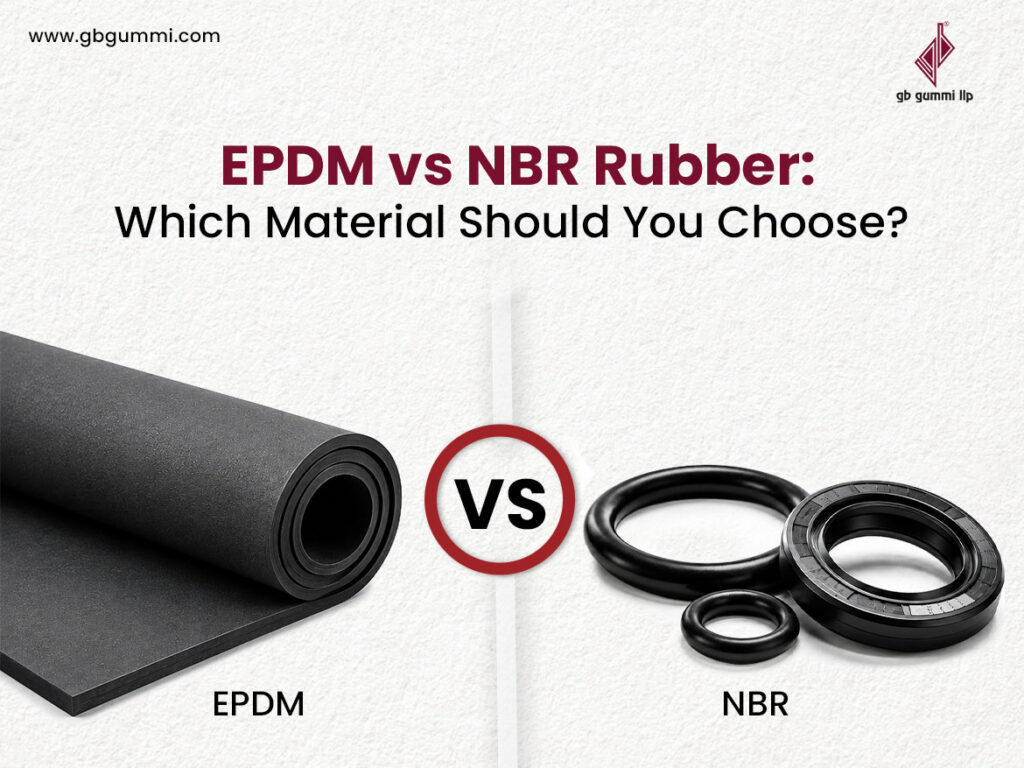
Choosing the right rubber material is important because it affects how well a product works and how long it lasts. When comparing EPDM vs NBR, many manufacturers want to know which one is better for their use. The answer depends on where the rubber will be used, how much heat it will be exposed to, whether it will come into contact with oil, and the environment it will work in.
Understanding EPDM vs NBR can help you choose the right material, reduce repair costs, and improve product life. Both are synthetic rubbers, but they are made for different uses.
In this blog, we will explain what EPDM and NBR are, compare EPDM vs NBR, highlight their differences and similarities, and help you choose the right rubber material for your needs.
What is EPDM?
EPDM rubber stands for Ethylene Propylene Diene Monomer, a synthetic rubber that offers excellent resistance to weather, ozone, sunlight, water, and heat. Because of these properties, it is widely used in outdoor applications or in environments with changing weather conditions.
Unlike many other rubber materials, EPDM rubber remains flexible even after long exposure to sunlight and moisture. In addition, it performs well in hot and cold temperatures, making it suitable for long-term outdoor use.
Common applications of EPDM rubber include
- Automotive weather seals.
- Roofing membranes.
- HVAC systems.
- Window and door seals.
- Electrical insulation.
- Expansion joints.
- Marine hatch and door seals.
- Fire protection system gaskets.
What is NBR?
NBR rubber, also known as Nitrile Butadiene Rubber, is a synthetic elastomer specially developed to resist petroleum oils, fuels, lubricants, and hydraulic fluids. Therefore, it has become one of the most widely used rubber materials in the automotive, manufacturing, and oil & gas industries.
Unlike EPDM, NBR rubber performs exceptionally well when exposed to oils and grease. Additionally, it provides excellent abrasion resistance, good mechanical strength, and reliable sealing performance in demanding industrial environments.
Today, industries use NBR rubber for O-rings, fuel hoses, hydraulic seals, oil seals, gaskets, rollers, and many other components that regularly come into contact with petroleum-based products.
EPDM vs NBR: Key Differences
When comparing EPDM vs NBR, the biggest difference lies in their resistance capabilities.
EPDM rubber performs best in outdoor environments because it offers excellent resistance to UV rays, ozone, rain, steam, and heat. As a result, it is the preferred choice for applications exposed to weather and moisture.
On the other hand, NBR rubber is specifically designed to handle oils, fuels, lubricants, and petroleum-based chemicals. Consequently, it is widely used in automotive engines, hydraulic equipment, industrial machinery, and fuel systems.
Another important difference is chemical compatibility. EPDM rubber performs well with water, steam, and mild chemicals but should not be used with petroleum oils. In contrast, NBR rubber performs extremely well with oils and fuels but offers lower resistance to ozone and direct sunlight.
Temperature performance also varies. While EPDM rubber generally performs better under continuous outdoor heat and weather exposure, NBR rubber is the better option for oil-rich industrial environments.
EPDM vs NBR: Similarities and Common Applications
Although there are several differences in EPDM vs NBR, both materials also share many valuable properties.
Both provide excellent flexibility, good tensile strength, and strong resistance to wear and compression. Moreover, both materials can be manufactured in different hardness grades to meet application requirements. Because of their durability, both materials are used in demanding operating conditions.
Common applications include seals, gaskets, O-rings, hoses, vibration dampers, bushings, molded rubber components, and custom-engineered industrial parts.
However, selecting the right material depends on the operating environment. For example, EPDM rubber works better for outdoor sealing applications, whereas NBR rubber performs better in systems exposed to oils and fuels. Therefore, understanding the working conditions before material selection always leads to better product performance.
EPDM vs NBR: What Should You Choose?
Choosing between EPDM vs NBR depends entirely on where and how the rubber component will be used.
If your application requires excellent resistance to weather, ozone, sunlight, water, steam, and high temperatures, EPDM rubber is the better choice. It is ideal for outdoor sealing systems, roofing, HVAC equipment, and water-based applications.
However, if your application regularly comes into contact with oils, fuels, grease, or hydraulic fluids, NBR rubber is the right option. It offers reliable sealing performance and long service life in automotive, industrial, and oil & gas applications.
Therefore, instead of selecting a material based only on cost, you should always evaluate the working environment, temperature range, and chemical exposure. This approach helps improve efficiency while reducing maintenance and replacement costs over time.
Choose the Right Rubber Material with GB Gummi
At GB Gummi, we believe that selecting the right rubber material is just as important as manufacturing the final component. That is why we carefully understand your application before recommending a solution. We consider factors such as operating temperature, pressure, chemical exposure, weather conditions, and mechanical requirements to ensure the material performs reliably.
Whether you require high-performance EPDM rubber for outdoor applications or durable NBR rubber for oil-resistant environments, we manufacture custom rubber solutions that meet demanding industrial requirements. Our focus is always on quality, consistency, and long-term performance.
At GB Gummi, we work closely with our customers to deliver rubber components that provide dependable performance, longer service life, and lasting value across industries.