
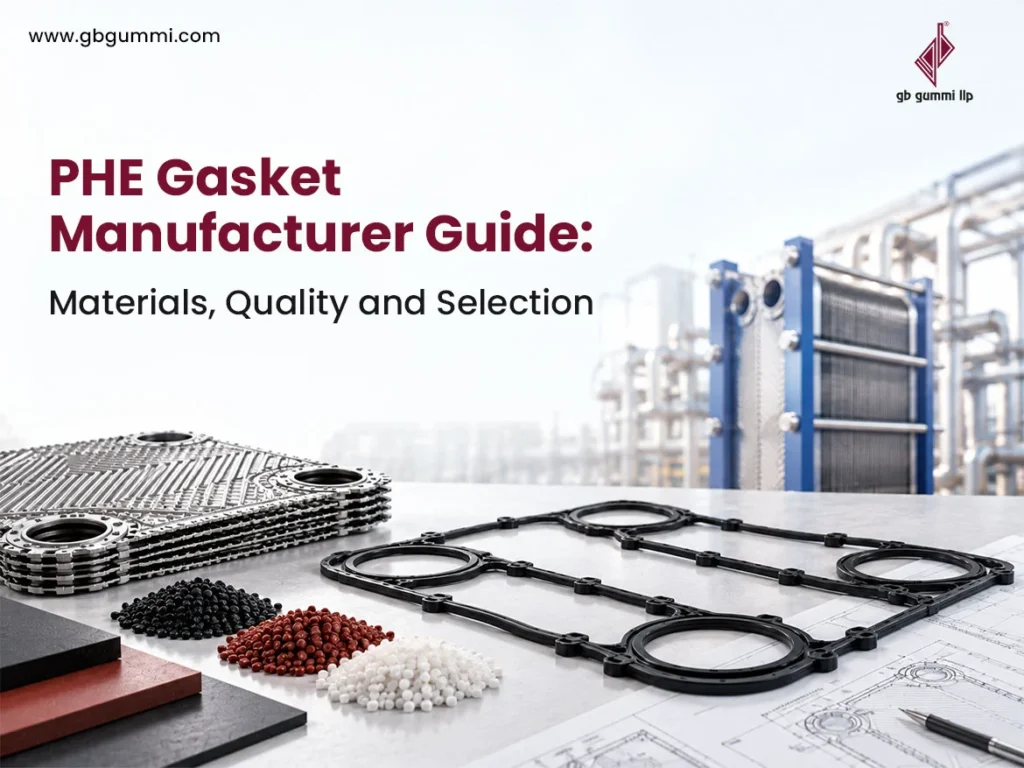
A plate heat exchanger needs reliable gaskets to prevent leaks and control fluid flow. These gaskets often face heat, pressure, and chemicals during use. So, gasket material quality is critical. Choosing the right PHE gasket manufacturer can improve sealing and extend gasket life.
Different applications need different rubber materials. For example, EPDM works well in hot water and steam-related environments, while NBR rubber is often preferred where oil resistance is required. For this reason, the gasket material should always match the actual working conditions.
In this blog, we will understand what PHE gaskets do, explore common gasket materials, and look at the key factors to consider when choosing a reliable PHE gasket manufacturer.
Why Choosing the Right PHE Gasket Manufacturer Matters
A plate heat exchanger, or PHE, uses a series of plates to transfer heat between fluids. Gaskets seal between these plates and help guide fluids through the correct channels.
Because these gaskets regularly face heat, pressure, and different fluids, their material and quality directly affect performance. A poorly suited gasket may wear faster, lose flexibility, or fail to create a proper seal.
Therefore, a reliable PHE gasket manufacturer should understand more than gasket dimensions. The manufacturer should also consider the complete operating environment before selecting or developing the rubber compound.
The right gasket can support:
- Reliable sealing between plates.
- Better resistance to operating temperatures.
- Compatibility with the fluid being processed.
- Longer service life.
- Consistent performance during repeated heating and cooling.
- Reduced risk of unexpected leakage.
As a result, material selection becomes one of the most important parts of gasket development.
How a PHE Gasket Manufacturer Selects the Right Material
No single rubber material suits every plate heat exchanger. Instead, manufacturers must match the compound to the conditions inside the equipment.
Some of the main factors to consider include:
- Operating temperature.
- Type of fluid or chemical.
- Exposure to oils and grease.
- Required hardness and flexibility.
- Pressure conditions.
- Frequency of heating and cooling cycles.
- Expected gasket life.
- Equipment and processing requirements.
For example, a gasket used with hot water may require different properties than one that regularly contacts oil. Similarly, chemical processing applications may need stronger resistance to specific substances.
Therefore, an experienced PHE gasket manufacturer evaluates the application before recommending a compound rather than choosing a material based only on its general properties.
EPDM for PHE Gasket Applications
EPDM is a widely used synthetic rubber known for its resistance to water, steam, ozone, weather, and several chemicals. As a result, it works well in plate heat exchanger applications involving hot water and certain water-based fluids.
Another important property of EPDM is its ability to remain flexible across a useful temperature range. This flexibility helps a gasket maintain a proper seal even when equipment experiences temperature changes.
However, EPDM does not offer strong resistance to petroleum-based oils and fuels. Therefore, manufacturers should carefully evaluate the fluid before selecting a gasket.
This highlights why material selection should always depend on the application rather than choosing a commonly used rubber without checking its limitations.
NBR Rubber for Oil-Related PHE Applications
NBR rubber, also known as nitrile rubber, is commonly selected when a gasket needs resistance to oils, greases, and several petroleum-based fluids.
Therefore, NBR rubber can be useful in plate heat exchangers where oil resistance is an important requirement. It also offers good mechanical strength, making it suitable for many industrial sealing applications.
However, like every rubber material, NBR has its limitations. It may not provide the same level of resistance to weather, ozone, or certain high-temperature environments as some other elastomers.
For this reason, choosing between EPDM and NBR rubber requires an understanding of the actual operating conditions. Neither material is automatically better. Instead, each performs well when used in the right environment.
What to Expect From a Reliable PHE Gasket Manufacturer
Material selection is only one part of producing a dependable gasket. A capable rubber company should also pay close attention to compound consistency, processing, dimensions, and the finished gasket’s performance requirements.
A good PHE gasket manufacturer should understand how changes in temperature, pressure, chemicals, and mechanical stress can affect rubber over time.
The compound formulation also matters greatly. Ingredients and curing systems can influence properties such as hardness, flexibility, compression behaviour, and chemical resistance. Consequently, two gaskets made from the same basic polymer can perform differently if their formulations are different.
So, businesses should consider both material knowledge and compound development experience when choosing a supplier.
Our Approach to Reliable Rubber Solutions at GB Gummi
At GB Gummi, we understand that gasket performance starts with choosing and developing the right rubber compound. Therefore, we study the application requirements before recommending a material or formulation.
We consider key factors such as temperature, pressure, fluid and chemical contact, hardness, and processing needs. Whether the application needs EPDM, NBR rubber, or another rubber material, we develop compounds that suit the working conditions.
As an experienced rubber company and PHE gasket manufacturer, we focus on good quality, the right material choice, and reliable performance. Our aim is to provide rubber solutions that help gaskets seal properly and work well in demanding industrial applications.