
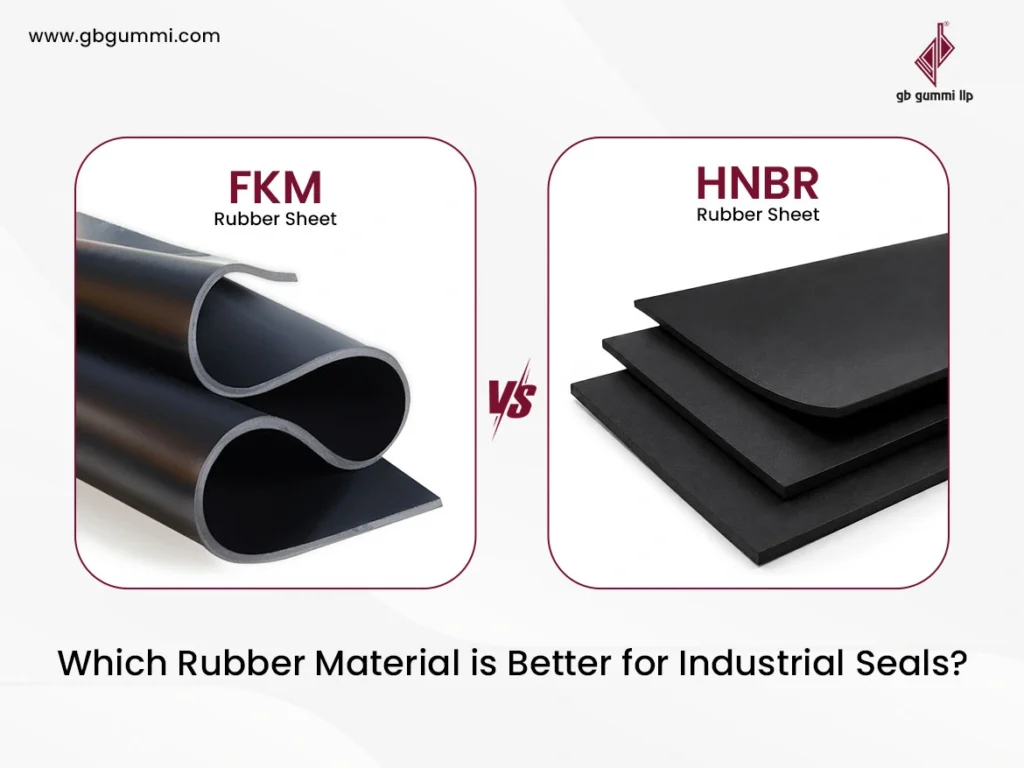
Choosing the right rubber material is important because it affects how well a product works and how long it lasts. The right material can also help reduce damage, wear, and the need for frequent replacement.
When comparing FKM vs HNBR, engineers look at heat resistance, chemical resistance, strength, and the working environment. Both materials offer good performance, but they are suitable for different types of applications.
In this blog, we will compare FKM vs HNBR based on temperature resistance, chemical resistance, strength, common uses, and how to choose the right material for your needs.
What Are FKM and HNBR?
Before comparing FKM vs HNBR, it is important to understand what each material is.
FKM elastomer is a high-performance rubber that can handle very high temperatures, oils, fuels, and harsh chemicals. Because of these properties, manufacturers use FKM Compound in industries such as automotive, aerospace, chemical processing, and oil & gas, where parts operate under harsh conditions.
On the other hand, HNBR rubber, also called HNBR material, is an improved version of nitrile rubber. It offers excellent resistance to heat, oil, wear, and mechanical stress. As a result, it is widely used in automotive parts, hydraulic systems, compressors, and industrial machines.
Although both materials are strong and durable, each one performs better in different situations.
FKM vs HNBR: Performance Comparison
To understand FKM vs HNBR, let’s compare their key performance characteristics.
Temperature Resistance
FKM elastomer performs well at temperatures from about -20°C to 250°C, depending on the compound. Therefore, it is a great choice for applications that involve very high heat.
In comparison, HNBR rubber usually works between -40°C and 150°C. While it cannot handle as much heat as FKM, it performs very well in many industrial applications.
Chemical Resistance
One of the biggest strengths of FKM Compound is its excellent resistance to chemicals, fuels, acids, solvents, and synthetic oils. Because of this, many industries choose FKM for demanding environments.
Meanwhile, HNBR material also resists oils, lubricants, fuels, and hydraulic fluids. However, it is not as resistant as FKM when exposed to very aggressive chemicals.
Mechanical Strength
When comparing FKM vs HNBR, strength is another important factor.
HNBR rubber offers excellent resistance to wear, tearing, and repeated movement. Therefore, it performs very well in applications where parts experience constant motion.
Although the FKM elastomer is also strong, its greatest advantage is its resistance to high temperatures and harsh chemicals.
Applications of FKM vs HNBR
The choice between FKM and HNBR depends on where the material will be used.
FKM Compound is commonly used in:
- Fuel system seals
- Chemical processing equipment
- Aerospace components
- Oil & gas equipment
- High-temperature O-rings
- Automotive engine seals
In comparison, HNBR material is widely used in:
- Automotive timing belts
- Hydraulic seals
- Compressor parts
- Industrial rollers
- Oilfield equipment
- Heavy industrial machinery
Therefore, industries usually choose FKM for high-temperature and chemical-heavy applications. However, they prefer HNBR for applications requiring greater wear resistance and mechanical strength.
How to Choose Between FKM vs HNBR?
Choosing between FKM vs HNBR depends on the working conditions of your application.
If your equipment is exposed to high temperatures, aggressive chemicals, fuels, or oils, FKM elastomer is usually the better choice. In addition, it provides excellent long-term performance in harsh industrial environments.
However, if your application requires greater wear resistance, flexibility, and strength during continuous movement, HNBR rubber is often the better option. It also performs well in automotive, hydraulic, and industrial equipment where chemical exposure is less demanding.
Before making a decision, always consider the operating temperature, chemicals involved, pressure, movement, and the component’s expected service life.
Choosing the Right Rubber Material With GB Gummi
At GB Gummi, we know that choosing between FKM vs HNBR is about more than comparing technical features. Every application has different requirements, and selecting the right material helps improve product performance and service life.
We manufacture high-quality FKM Compound and HNBR material for industries such as automotive, aerospace, oil & gas, chemical processing, power generation, and industrial manufacturing. Our team works closely with customers to understand their requirements and recommend the best solution.
Whether you need the excellent chemical resistance of FKM elastomer or the superior mechanical strength of HNBR rubber, we are committed to delivering reliable rubber compounds that perform in demanding industrial environments.