
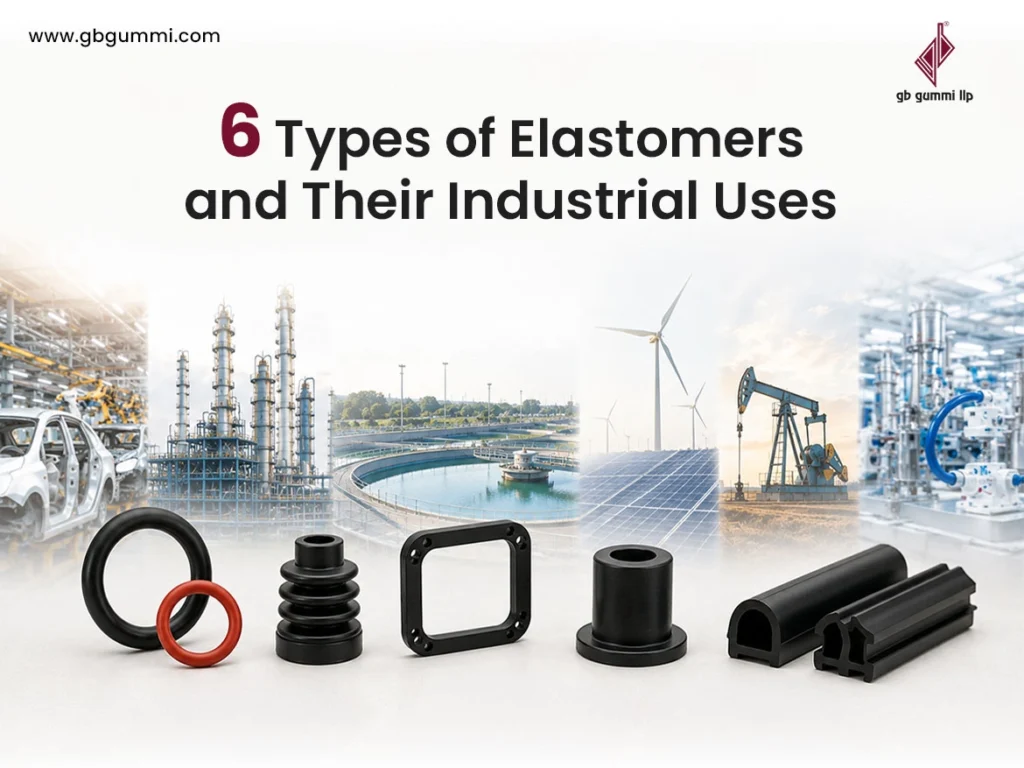
Elastomers are flexible materials that can stretch and return to their original shape. They are commonly used in seals, hoses, tires, gaskets, belts, and many other industrial products. However, different types of elastomers offer different levels of strength, heat resistance, and chemical protection.
For example, some elastomers work well in outdoor conditions, while others can handle oils, fuels, or very high temperatures. Therefore, choosing the right material is important for product safety, performance, and service life.
In this blog, we will explain six common types of elastomers in simple language. We will also examine their key properties and the industries where they are commonly used.
Why the Types of Elastomers Matter
Every industrial application has different needs. A rubber part used in a car engine faces different conditions from one used in a water pipe or a conveyor belt.
Therefore, manufacturers must consider heat, pressure, chemicals, weather, and movement before choosing a material. The right elastomer can last longer, reduce repair needs, and improve the final product’s performance.
Although many rubber materials may look the same, they behave differently under stress. Understanding the main types of elastomers helps businesses choose the material that suits their application.
1. Natural Rubber Compound
A natural rubber compound comes mainly from natural latex. It is highly flexible and can stretch easily without breaking. It also has good tear strength and absorbs shock well.
Because of these qualities, manufacturers use it in conveyor belts, vibration mounts, industrial rollers, tires, and shock-absorbing parts. It also works well in products that bend or move repeatedly.
However, natural rubber does not perform well in the presence of oils, fuels, sunlight, or harsh weather. Therefore, it is better for general applications where chemical exposure is limited.
2. SBR Rubber
SBR rubber stands for Styrene-Butadiene Rubber. It is one of the most commonly used synthetic rubbers because it is strong, affordable, and wear-resistant.
As a result, manufacturers use SBR rubber in tires, shoe soles, flooring, gaskets, conveyor belts, and general rubber products. It performs well in applications where rubbing and surface wear happen regularly.
However, it has limited resistance to oils, fuels, and strong chemicals. Therefore, it works best in applications where wear resistance matters more than chemical resistance.
3. EPDM Rubber
EPDM rubber is known for its excellent resistance to sunlight, ozone, rain, steam, and changing weather conditions. It also stays flexible across a wide temperature range.
For this reason, manufacturers use EPDM rubber in automotive door seals, roofing sheets, water pipes, HVAC systems, and outdoor equipment. It is especially useful when the rubber part remains outside for long periods.
However, EPDM does not work well with petroleum oils and fuels. Therefore, it is not usually selected for fuel systems or oil-handling equipment.
4. HNBR Rubber
HNBR rubber is a strong and improved form of nitrile rubber. It offers good resistance to oils, heat, pressure, and mechanical wear.
Because of this balance, manufacturers use HNBR rubber in automotive seals, hydraulic systems, oil and gas equipment, industrial machinery, and high-pressure applications.
In addition, HNBR remains strong in difficult working conditions. Therefore, it is a suitable choice for parts that need both oil resistance and long-term durability.
5. FKM Elastomer
An FKM elastomer is a high-performance rubber material. It can handle high temperatures, fuels, oils, chemicals, and aggressive fluids better than many standard rubbers.
Therefore, manufacturers use an FKM elastomer in O-rings, seals, gaskets, fuel systems, chemical plants, aircraft, and automotive engines. It is especially useful in places where normal rubber may become hard, weak, or damaged.
Although FKM costs more than common rubber materials, it often lasts longer. As a result, it can reduce replacement and maintenance costs over time.
6. FFKM Elastomers
FFKM elastomers offer one of the highest levels of heat and chemical resistance among rubber materials. They can handle very aggressive chemicals and extreme industrial conditions.
Because of this, FFKM elastomers are used in semiconductor plants, pharmaceutical equipment, aerospace systems, chemical processing units, and other critical applications.
However, FFKM is more expensive than most other elastomers. Therefore, manufacturers usually select it only when other rubber materials cannot provide enough protection.
How to Choose Between the Types of Elastomers?
Choosing the right elastomer starts with understanding the working conditions. First, check the highest and lowest temperatures the material will face. Next, identify any oils, fuels, chemicals, water, or steam that may come into contact with it.
You should also check how much pressure, movement, outdoor exposure, and daily use the material will face. For example, a natural rubber compound is a good choice when the part needs to bend, stretch, or absorb shock. On the other hand, EPDM rubber works better in rain, sunlight, and water.
In the same way, HNBR rubber performs well in oil and at high pressure. An FKM elastomer is better for high heat and strong chemicals. For very harsh conditions, FFKM elastomers may offer the best protection.
Therefore, comparing the different types of elastomers helps manufacturers avoid early failure and choose a safer, longer-lasting material.
Choose the Right Elastomer with GB Gummi
At GB Gummi, we understand that every industrial application has different requirements. Therefore, we first study the operating temperature, chemical exposure, pressure, movement, and product expectations.
Based on these needs, we help customers select suitable materials such as natural rubber compound, SBR rubber, EPDM rubber, HNBR rubber, FKM elastomer, and FFKM elastomers.
We focus on quality, consistency, and reliable performance. With our material expertise and manufacturing experience, we develop rubber solutions that meet the demands of demanding industrial applications and support long-term product performance.