
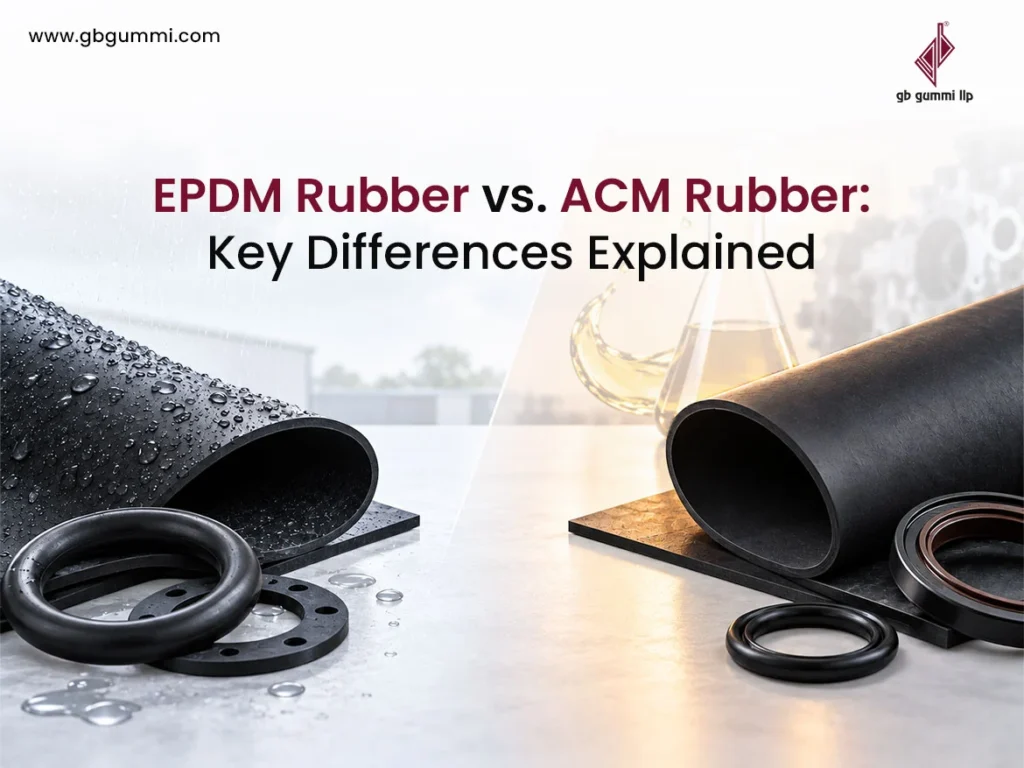
Rubber parts are used in cars, buildings, machines, and many other products. These parts often face heat, rain, sunlight, oil, water, and other tough conditions. However, every type of rubber reacts differently to these conditions. Therefore, understanding EPDM vs ACM can help manufacturers choose the right material for their needs.
EPDM rubber works well against weather, ozone, water, and sunlight. On the other hand, ACM rubber performs well in heat and with automotive oils. As a result, choosing the right rubber can help parts last longer and perform better.
In this blog, we compare EPDM vs ACM, explain their main properties and uses, and help you decide which material suits different applications.
What Is the Difference Between EPDM vs ACM?
EPDM stands for Ethylene Propylene Diene Monomer. It is a synthetic rubber known for strong resistance to weather, sunlight, ozone, and water. Because of these properties, EPDM material is often used for parts that stay outdoors or regularly face changing weather.
Manufacturers can also develop EPDM compounds with different levels of hardness, flexibility, and temperature resistance. As a result, manufacturers use EPDM in many automotive, construction, and industrial applications.
ACM, also called acrylic rubber, offers different benefits. ACM rubber provides good resistance to heat and automotive oils. Therefore, it is commonly used for parts found under the hood of vehicles and in other areas where both heat and oil are present.
Both materials are durable. However, their different properties make them suitable for different uses.
Key Properties of EPDM vs ACM
When comparing EPDM vs ACM, it helps to understand the conditions the rubber part will face. Some of the main differences include:
- Weather resistance: EPDM rubber performs well against sunlight, rain, ozone, and changing weather. Therefore, it is a good option for many outdoor applications.
- Oil resistance: ACM rubber offers better resistance to many automotive oils and lubricants.
- Water resistance: EPDM performs well in wet and moist environments. As a result, it is commonly used in seals and hoses.
- Heat resistance: ACM can handle higher temperatures, especially in applications where heat and oil are present together.
- Aging resistance: EPDM can maintain its properties even after long exposure to outdoor conditions.
- Flexibility: A properly developed EPDM compound can remain flexible under different working conditions.
Therefore, manufacturers should compare these properties with their application needs before choosing a material.
Choosing EPDM vs ACM for Your Application
Choosing between EPDM vs ACM depends on where and how the rubber part will be used. Instead of focusing on only one property, manufacturers should consider the full working environment.
Important factors include:
- Minimum and maximum working temperature
- Contact with oil, lubricants, water, or other fluids
- Exposure to sunlight, ozone, rain, and weather
- Required hardness and flexibility
- Movement and mechanical stress
- Expected life of the rubber component
For example, EPDM can suit a seal that regularly faces sunlight, rain, and changing weather. However, a part that contacts hot automotive oil may need ACM rubber.
The rubber formulation also affects performance. Therefore, working with an experienced rubber compound manufacturer can help businesses choose a compound that matches their actual requirements.
EPDM vs ACM Applications Across Industries
The differences between EPDM vs ACM also become clear when we look at where these materials are commonly used.
EPDM rubber is widely used in automotive weather seals, coolant hoses, window seals, construction gaskets, roofing products, and other outdoor components. Since it handles weather and water well, it is useful for parts that face outdoor conditions for long periods.
Meanwhile, ACM rubber is often used in automotive seals, transmission parts, oil hoses, and gaskets. Since it performs well around heat and automotive oils, ACM is useful for many under-the-hood applications.
However, every application has different needs. For example, a construction seal exposed to rain has very different requirements from a seal used near hot automotive oil. Therefore, manufacturers should always consider the actual working conditions before choosing the rubber.
EPDM vs ACM: Which Material Suits Different Conditions?
The right choice between EPDM vs ACM mainly depends on what the rubber component needs to handle.
EPDM is generally suitable when the main concerns are sunlight, ozone, rain, water, and changing weather. Therefore, manufacturers commonly use it for outdoor seals, hoses, and weather-resistant components.
On the other hand, ACM is useful when a component needs to handle both heat and automotive oils. As a result, manufacturers often choose it for automotive and under-the-hood applications.
However, manufacturers should not choose a material based on only one property. Before making the final choice, consider temperature, oil exposure, weather, flexibility, mechanical stress, and expected service life.
GB Gummi for Application-Specific Rubber Compounds
At GB Gummi, we understand that every rubber application has different requirements. Therefore, we develop compounds based on the conditions in which the final component will operate.
As an experienced rubber compound manufacturer, we consider factors such as heat, weather, oil exposure, flexibility, durability, and processing needs while developing rubber compounds.
Whether an application needs the weather resistance of an EPDM compound or the heat and oil resistance of ACM rubber, we work with customers to understand their specific needs.
At GB Gummi, we develop rubber compounds that offer the right balance of strength, flexibility, resistance, and long-term performance. This helps manufacturers choose materials that can perform reliably in their intended applications.